Lesson 01.01 · How acrylic behaves · 8 minutes
Wet paint and dry film
You will learn to use acrylic’s change from movable paint to permanent film.
Review 00.03 · Paint a simple sphere if you need it.
See it
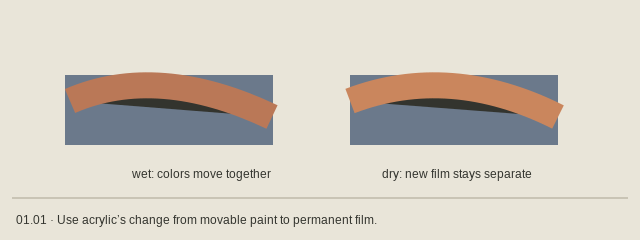
Read
When two wet acrylic colors touch, the brush can carry one into the other. When a thin coat is dry, a new stroke can cross it without mixing the colors. Use that difference to make repairs. Test drying on scrap painted at the same time and thickness. A dull surface can still be tacky, especially where a stroke is thick.
Terms in this lesson · acrylic binder
Try it
Optional screen activity · Drying Lab: wet-to-dry demonstration
Paint it
Gather your materials
- One dark color and white
- Medium brush, water jars and rag
- Sturdy scrap card
All exercise steps
- Label two areas Dry first and Wet first. Pull a dark stroke about 4 cm long in Dry first. Spread it into a thin, even coat with one pass of the brush.
- Make a second thin test mark of the same dark paint in a margin. Rinse and blot the brush. Wait until a light touch on that mark feels dry and leaves no paint on your finger.
- Load the same dark paint and make a fresh stroke in Wet first. Leave a small ridge of paint at one end so you can see the difference in thickness.
- Rinse and blot the brush. Load white and pull one short stroke across the fresh dark mark. Rinse and blot again, reload white, and cross the dry dark mark with a second stroke.
- Inspect both crossings and the thicker ridge. If the ridge still shines or looks wet, leave it to dry while you label the two results.
Check
What should I be seeing?
White picks up some dark color at the wet crossing. At the dry crossing, the white stays separate on top even if a little of the base shows through.
Fix
If both crossings smear, test a fresh scrap mark for dryness before repainting the dry sample. If neither mixes, prepare a new wet stroke and cross it immediately.
Save
Save a physical swatch or painting photograph in your journal. Use the lesson number in its note.