P06 · difficulty 1/3 · 45–60 minutes
Three-band sky
Make a broad controlled gradient and add simple clouds after drying.
Prepare for this project
Required course practice after Module 07 · Blending and working time.
Prerequisite lessons
- 05.03 · Make a tint ladder with white
- 07.01 · Control open time
- 07.02 · Make a wet-on-wet blend
- 07.03 · Make a wet-on-dry transition
- 07.04 · Paint a sky gradient
Skills you will practise
- Prepare three piles before painting
- Join wet bands with controlled strokes
- Repair a dry seam with a bridge color

Prepare the surface and paint
- Surface
- 20 × 30 cm primed surface
- Brushes and tools
- Largest flat brush available, medium filbert for clouds.
- Drying breaks
- Allow at least 1 break; test the scrap swatch before another layer.
Titanium White, Cerulean Blue or Phthalo Blue, Ultramarine, Lemon Yellow, optional Vermilion. A small Burnt Sienna dab mutes the cloud shadow; Vermilion can substitute in pinhead amounts.
Your project palette
Choose your paints to match these roles to your own tubes. You can also follow the listed palette above.
Make the value plan first

Use the supplied reference as framed, or use your own photo. Open it in the Value Lab and choose 3 values to see the large light, middle and dark shapes.
Open Value Lab · Make a painting sheet
Check your dry light, middle and dark swatches against the plan.
Numbered stages
- Mix top, middle, and horizon colors before painting.
Mixture, brush and checkpoint
Mixture: Top: Ultramarine 1 + Cerulean 1 + White 2. Middle: top 1 + White 1. Horizon: White 8 + Yellow 1/8. Substitute a pinhead of Phthalo for Cerulean if needed.
Tool and motion: Palette knife: prepare the three endpoint piles before the brush touches the surface.
Check: Three dry-test swatches step smoothly from a darker top to lighter horizon.
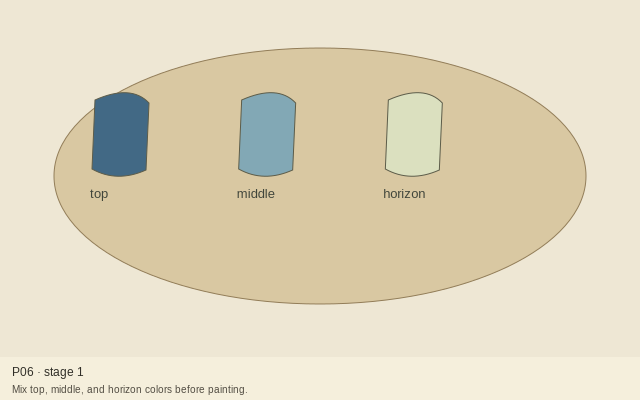
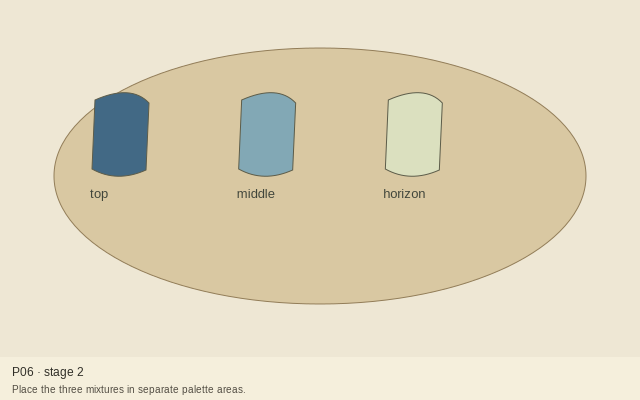
- Place the three mixtures in separate palette areas.
Mixture, brush and checkpoint
Mixture: Keep all three piles separate and large enough to cross the whole surface width.
Tool and motion: Palette knife: separate the top, middle and horizon piles around the palette edge.
Check: There is enough of each mixture to work without remixing mid-band.
- Paint the top band across the full width.
Mixture, brush and checkpoint
Mixture: Use the top sky mixture with a damp, blotted large flat brush.
Tool and motion: Largest flat available: load both faces, then pull long horizontal strokes across the full width.
Check: The top band covers the full width with an open wet edge.

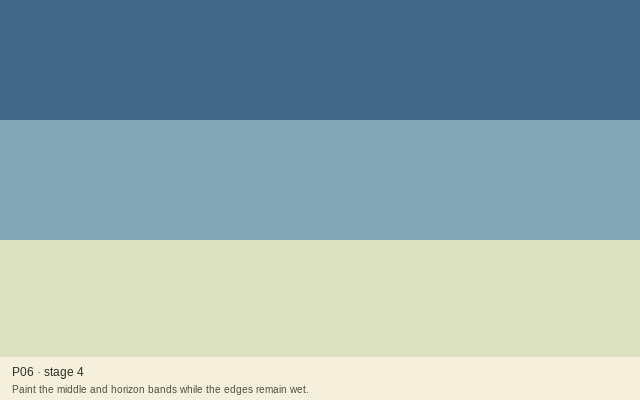
- Paint the middle and horizon bands while the edges remain wet.
Mixture, brush and checkpoint
Mixture: Use the middle and horizon piles; overlap only the neighboring wet edges.
Tool and motion: Largest flat: place the middle and horizon bands across the full width while adjoining edges remain wet.
Check: All three bands meet before their edges turn tacky.
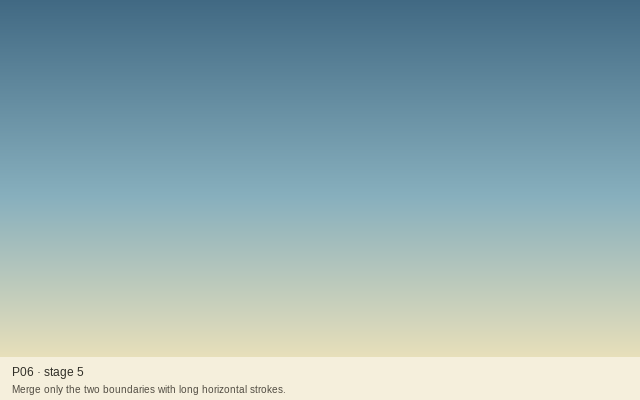
- Merge only the two boundaries with long horizontal strokes.
Mixture, brush and checkpoint
Mixture: Use a little of each neighboring mixture at the boundary; do not sweep all three into one pile.
Tool and motion: Clean damp large flat: make a few long horizontal passes across each join, then stop.
Check: The two joins change gradually without a gray overworked center.
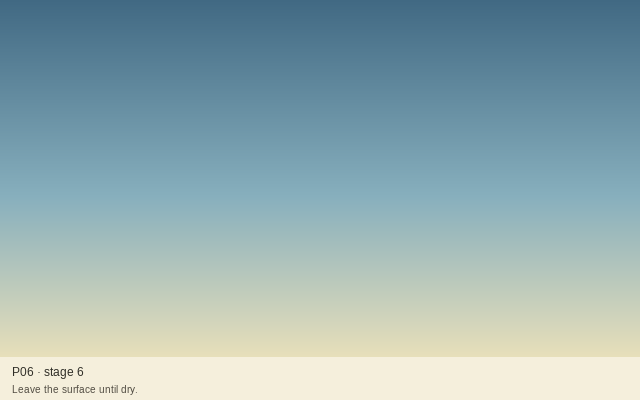
- Leave the surface until dry.
Mixture, brush and checkpoint
Mixture: No new paint. Leave the sky undisturbed until the scrap swatch is dry.
Tool and motion: Scrap swatch: test the surface state without touching the sky; wait until dry.
Check: The scrap swatch is dry before clouds are added.
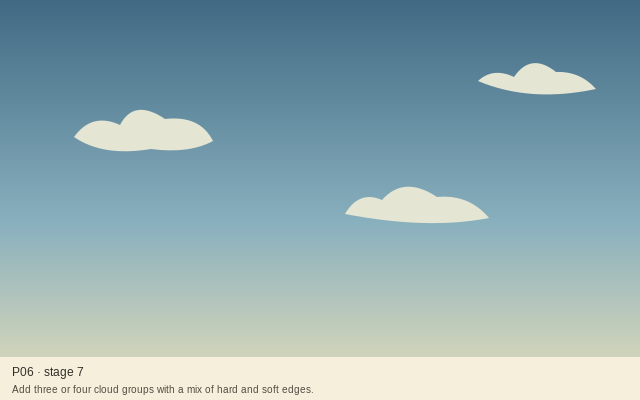
- Add three or four cloud groups with a mix of hard and soft edges.
Mixture, brush and checkpoint
Mixture: Cloud light: White 8 + sky mixture 1. Cloud shadow: sky 2 + White 1 with a pinhead of Sienna.
Tool and motion: Medium filbert: press broad cloud groups, then soften only selected edges with a clean damp brush.
Check: Three or four cloud groups remain secondary to the broad gradient.
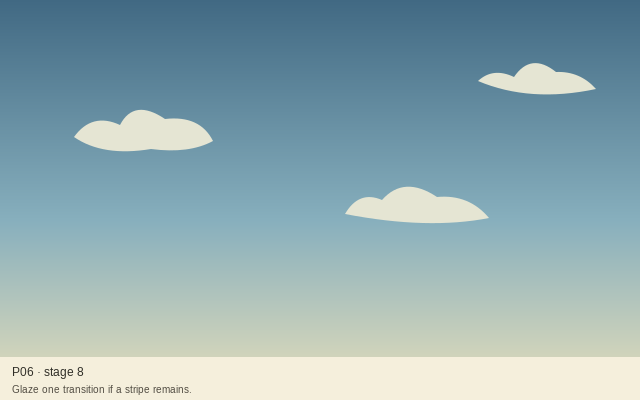
- Paint a bridge color over a dry seam if a stripe remains.
Mixture, brush and checkpoint
Mixture: Take a small part of each neighboring band and mix them into a middle color, as in Lesson 07.03. Dry-test it before touching the painting.
Tool and motion: Use a soft flat brush to paint one narrow strip over the dry seam. Skim the two fresh edges lightly with the blotted brush.
Check: The two bands remain distinct at their centers and meet with a softer transition.
Checkpoint pictures
Check the painting
The sky changes gradually and the horizon is lighter than the top without a pale chalky band.
Repairs
- Dry seam. Let it dry and use a narrow bridge of the two neighboring colors.
- Gray center. Stop cross-brushing and restore the neighboring colors.
- Small busy clouds. Merge them into larger groups.