Lesson 08.03 · Build with layers · 18 minutes
Make a glaze
You will learn to shift a dry color while preserving the layer below.
Review 08.02 · Use an underpainting if you need it.
See it
Read
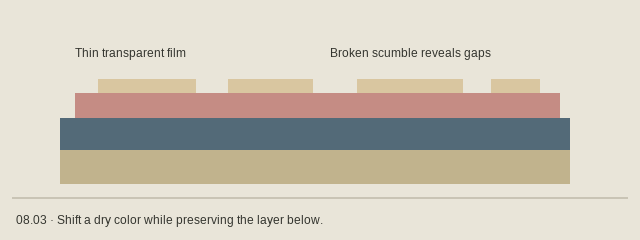
A glaze is a thin transparent layer brushed over dry paint. It changes the color while letting the earlier values show. Choose a paint that let the stripe show in Lesson 01.03. Mix it into compatible acrylic glazing medium. For this exercise, the light, middle and dark base should stay easy to distinguish.
Terms in this lesson · glaze
Try it
Optional screen activity · Layer Lab: glaze stack
Paint it
Gather your materials
- Transparent red or blue from your opacity test
- Compatible acrylic glazing or fluid medium if available
- Dry three-value stripe
- Soft brush, palette, water jars and rag
All exercise steps
- Paint three touching value squares on scrap using your light, middle and dark. Let a small test dash of the same thickness dry to a light touch.
- Put one small part of the transparent color on your palette. Stir in glazing medium following its directions. If no starting ratio is provided, try one small dab of paint to about ten equal dabs of medium on scrap. Fold together until even.
- Try one thin stroke over a spare patch of dry paint. If the base disappears, stir more medium into the glaze and test again. If you have no medium, test a thin stroke of your most transparent tube paint and compare it with the dry base.
- Load a damp, blotted soft brush. Pull one even coat across the lower half of the main three-value strip, leaving the upper half exposed. Leave it flat until dry, then paint a second thin coat over only part of the first.
- Compare the uncovered base, one-coat area and two-coat area. Keep the strip for Lesson 08.04.
Check
What should I be seeing?
All three base values are still visible through the tinted area. The second coat changes the color more than the first.
Fix
If the layer shows streaks or ridges, use a smaller load and a softer brush. Spread the next test coat once, then leave it to level and dry.
Save
Save a physical swatch or painting photograph in your journal. Use the lesson number in its note.
Supplementary demonstration
Liquitex: 4 Minutes On Glazing Techniques With Acrylic Paint · 4 minutes
Use platform captions when available. Follow the complete written glazing instructions on this page. Embedding depends on the video platform; the source link remains available.