Lesson 03.01 · Control the brush · 10 minutes
Load, place, and pull
You will learn to make an even stroke without flooding or starving the brush.
Review 02.04 · Surfaces, grounds, and homemade supports if you need it.
See it
Read
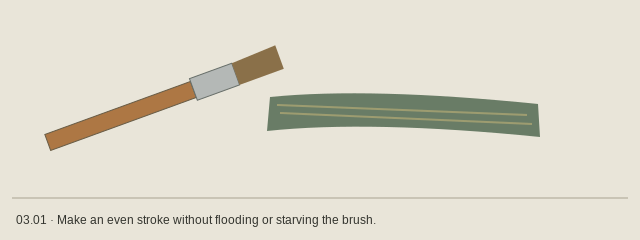
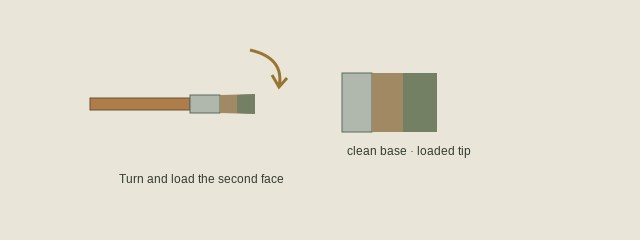
A good load puts paint on the bristles where it can transfer to the paper. Keep paint away from the metal ferrule so it will rinse out. Hold the brush like a pencil with a relaxed grip. Set the head down, pull in one direction, then lift. Compare too little, enough and too much paint.
Loading a flat brush · silent demonstration
Try it
Optional screen activity · Brush Lab: load challenge
Paint it
Gather your materials
- One acrylic color, medium flat or round brush
- Palette, scrap card, water jars and rag
All exercise steps
- Rinse, dampen and blot the brush. Pull each face of a flat brush through a small pile of paint so the lower half of the bristles is coated. With a round, turn it once in the paint to coat both sides.
- Rest the heel of your hand lightly on the table. Touch the brush down until the bristles bend a little. Pull for about three brush lengths, then lift.
- Blot the paint from both faces on scrap and pull a second stroke beside the first without reloading. Use the same speed and pressure.
- Scoop a visibly larger amount onto the lower half of the bristles and make a third stroke. Check for a ridge at its start or along the edge.
- Label the stripe that stayed even. Reload to match it and paint one more stripe.
Check
What should I be seeing?
The first and last strokes have even coverage for most of their length. The unloaded stroke tends to skip and the heaviest stroke tends to leave a ridge.
Fix
If an even stripe stops halfway, reload the brush. If each stripe begins with a lump, drag the brush once over a clear part of the palette before placing it.
Save
Save a physical swatch or painting photograph in your journal. Use the lesson number in its note.
Supplementary demonstration
The Art Sherpa: Acrylic Techniques Everything a Beginner Needs to Know · Long-form demonstration
Platform captions; the written lesson and original diagram cover the exercise. Embedding depends on the video platform; the source link remains available.