Lesson 02.04 · Materials you already own · 12 minutes
Surfaces, grounds, and homemade supports
You will learn to prepare a surface that accepts acrylic evenly.
Review 02.03 · Choose and use four brushes if you need it.
See it
Read
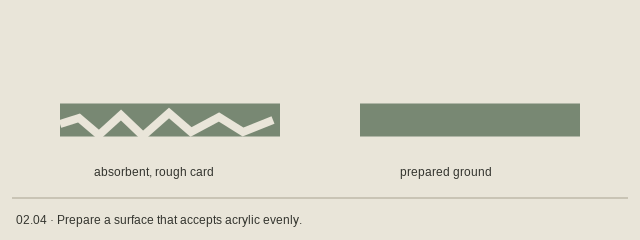
The support is what you paint on. A ground is a coat you put on first to prepare that surface. Bare card can pull moisture out of a brushstroke quickly. A ground such as acrylic gesso can give paint a more even surface to spread on. Compare two pieces of the same card so the preparation is the main difference.
Terms in this lesson · absorbent surface · ground · support
Try it
Optional screen activity · Surface comparison record
Paint it
Gather your materials
- Two equal pieces of sturdy uncoated card
- Gesso or acrylic ground if available
- One acrylic color and a flat brush
- Tape, scrap board, palette, water jars and rag
All exercise steps
- Tape the corners of both pieces to a board. Label one Bare and one Ground. If you have no ground, use a piece of canvas paper for comparison and label it with its actual surface.
- If using ground, load the flat with a small amount. Pull it across one piece in overlapping strokes, spreading it to a thin coat without puddles. Follow the ground's drying directions. Wash the brush.
- Load a damp, blotted brush with your paint. Pull a 4 cm stripe on Bare. Reload with about the same amount and pull a stripe on Ground.
- Use the tip of the same brush to extend one end of each stripe while wet. Then leave both untouched until dry. Compare drag, coverage and any warping.
- Choose which surface you would use for several adjoining strokes. Write which let you move the paint more easily.
Check
What should I be seeing?
The test strokes show how the support changes the feel and coverage. Grounded or primed paper often lets the paint travel farther before it catches.
Fix
If the card curls, use less liquid on the next piece and let it dry taped flat. If the first coat of ground is patchy, let it dry and apply another thin coat following its label.
Save
Save a physical swatch or painting photograph in your journal. Use the lesson number in its note.