Lesson 10.02 · Drawing and composition · 15 minutes
Find large shapes and negative space
You will learn to draw the subject through silhouettes and surrounding gaps.
Review 10.01 · Crop the reference if you need it.
See it
Read
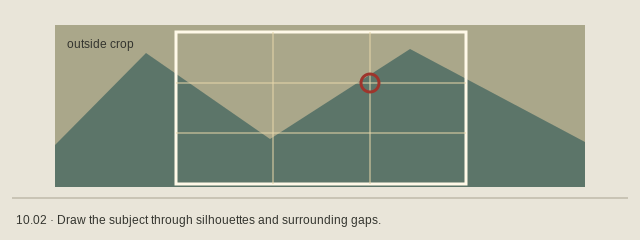
A silhouette is the subject's outside shape. A negative space is an empty shape around or between objects, such as the hole inside a mug handle. The edges of a gap can help you place an object. Look at its width, height and tilt before adding interior detail.
Terms in this lesson · negative space
Try it
Optional screen activity · Reference Desk: silhouette overlay
Paint it
Gather your materials
- Pencil and paper
- Side-lit mug or Three-object still life practice image
- Reference Desk or a printed reference
All exercise steps
- View the reference at a small size. In Reference Desk, open Value and raise Squint blur until the small details fade but the outlines are still visible.
- Draw a small frame of the same shape as the reference. Pencil the outside contour of the mug or main object. Fill the silhouette lightly with pencil.
- Find two gaps, such as the hole inside the handle and the space from the mug to the frame. Trace their boundaries on your sketch. Compare how wide they are at the top, middle and bottom.
- Erase and redraw one edge if it crowds a gap or leaves too much room. Check the silhouette again before adding detail.
Check
What should I be seeing?
The outside shape reads as the subject. The empty shapes sit in the same places and have similar proportions to the reference.
Fix
If the handle looks too thick, compare the hole first and make it wider or taller before changing the outside edge.
Save
Save a physical swatch or painting photograph in your journal. Use the lesson number in its note.