P01 · difficulty 1/3 · 30–40 minutes
Five-value sphere
Make a flat circle read as a solid form with five values.
Watch this tool · Part 1, 9:32 — Prepare a five-value sphere; transcript available.
Prepare for this project
Optional project after Module 04 · Value and form.
Prerequisite lessons
- 00.02 · Mix paint and make five values
- 00.03 · Paint a simple sphere
- 04.03 · Turn a circle into a sphere
- 04.04 · Cast shadow and reflected light
Skills you will practise
- Mix five distinct values
- Paint a turning form
- Place contact shadow and reflected light
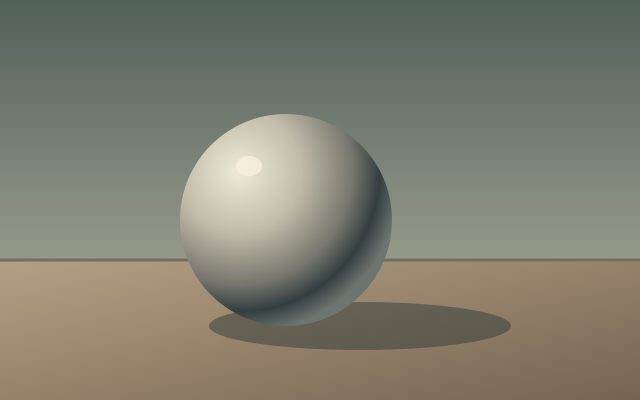
Prepare the surface and paint
- Surface
- A5 canvas paper or primed card
- Brushes and tools
- Medium filbert or flat, small round, palette knife, rag.
- Drying breaks
- Allow at least 1 break; test the scrap swatch before another layer.
Use Titanium White or another covering white and the dark paint from your first sphere. Black works. For a two-color version, start with equal parts Ultramarine and Burnt Sienna. Add a small dab of brown if the mixture looks blue or a small dab of blue if it looks brown. Fold in each addition and check a thin swatch.
Your project palette
Choose your paints to match these roles to your own tubes. You can also follow the listed palette above.
Make the value plan first
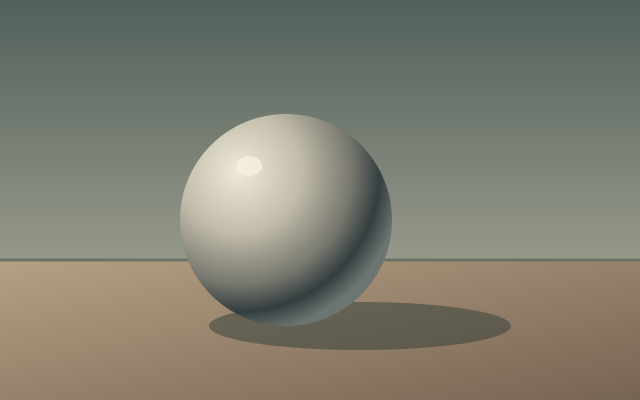
Use the supplied reference as framed, or use your own photo. Open it in the Value Lab and choose 3 values to see the large light, middle and dark shapes.
Open Value Lab · Make a painting sheet
Check your dry light, middle and dark swatches against the plan.
Numbered stages
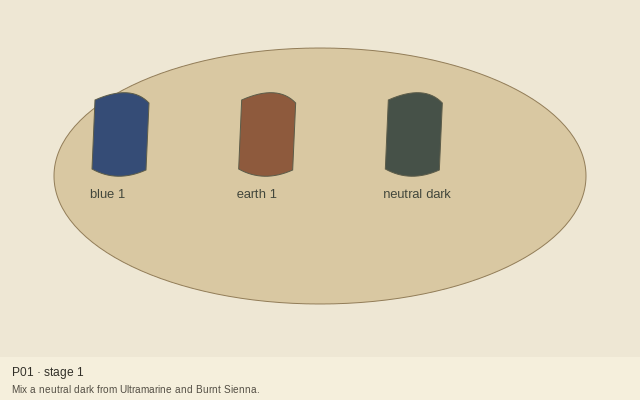
- Prepare one dark paint for all five values.
Mixture, brush and checkpoint
Mixture: Start with a pea-sized pile of your dark paint. For a two-color dark, fold one part Ultramarine into one part Burnt Sienna and adjust with a tiny dab as needed.
Tool and motion: Use a clean palette knife to move paint. If mixing two colors, spread and fold the pile until no streaks remain, then wipe the blade.
Check: One uniform dark paint is ready on the palette.
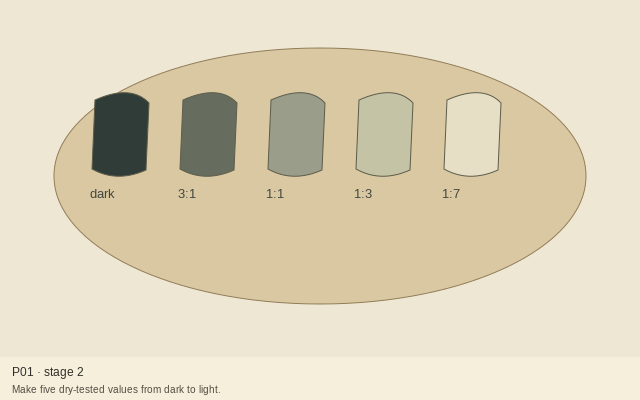
- Make five dry-tested values from dark to light.
Mixture, brush and checkpoint
Mixture: Follow Lesson 00.02. Keep 1 dark and 5 white. Fold a little dark into white to make 3. Split two small portions from 3. Add dark to one for 2 and white to the other for 4. Dry-test the five swatches and adjust until adjacent steps are distinct.
Tool and motion: Palette knife for five separate piles; medium flat for five even test squares.
Check: All five dry squares differ clearly from both neighbors.
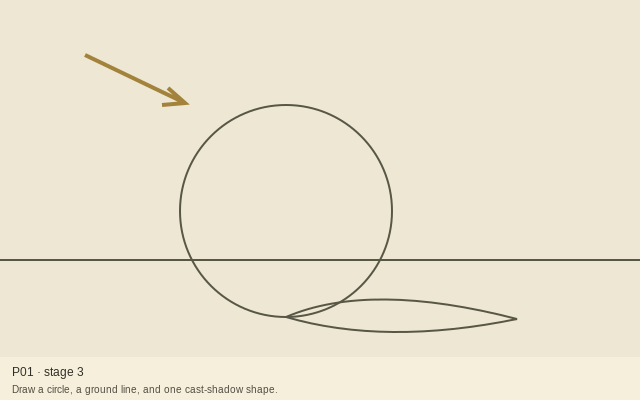
- Draw a circle, a ground line, and one cast-shadow shape.
Mixture, brush and checkpoint
Mixture: No new mixture. Keep the five piles covered while drawing.
Tool and motion: Light pencil: draw a circle and the attached shadow outline without pressing into the surface.
Check: The circle is closed and the cast-shadow shape touches its base.
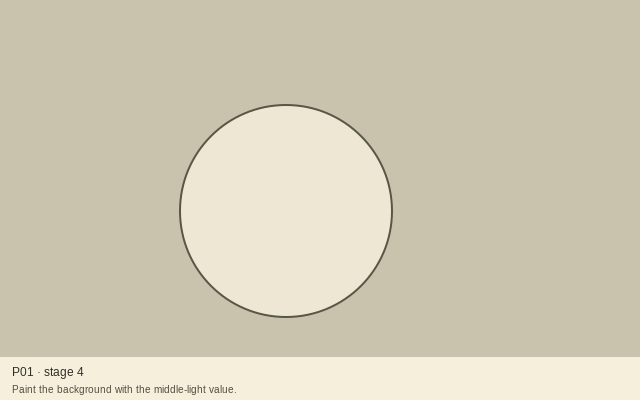
- Paint the background with the middle-light value.
Mixture, brush and checkpoint
Mixture: Use the fourth value, one step below the lightest. Spread a thin covering coat.
Tool and motion: Large flat: load both faces and pull overlapping strokes around the reserved circle.
Check: The background covers the white surface without thick ridges.
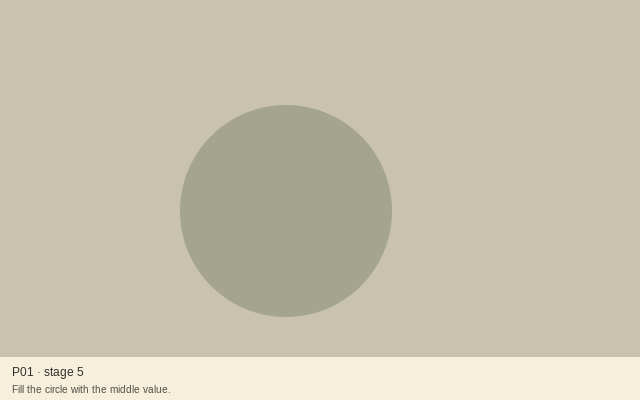
- Fill the circle with the middle value.
Mixture, brush and checkpoint
Mixture: Use the third, middle-value pile. Keep the first silhouette simple.
Tool and motion: Medium filbert: cover the circle with broad strokes, working inward from its silhouette.
Check: One clean middle-value silhouette fills the circle.
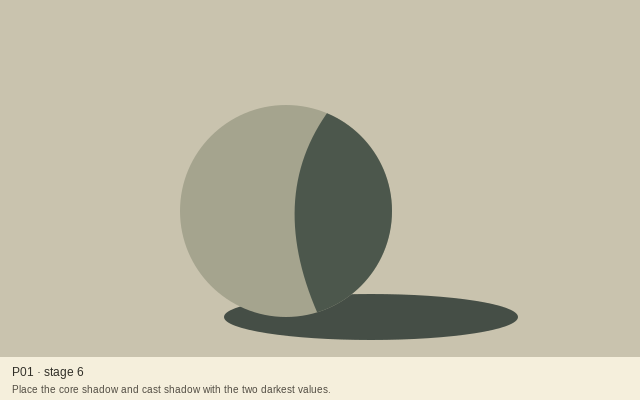
- Place the core shadow and cast shadow with the two darkest values.
Mixture, brush and checkpoint
Mixture: Use the darkest pile at the contact; use the second-darkest for the broad core and cast shadows.
Tool and motion: Medium filbert: place one connected core-shadow shape; use a flat for the cast shadow and a round tip at the contact.
Check: The light side, core shadow and cast shadow remain three connected masses.
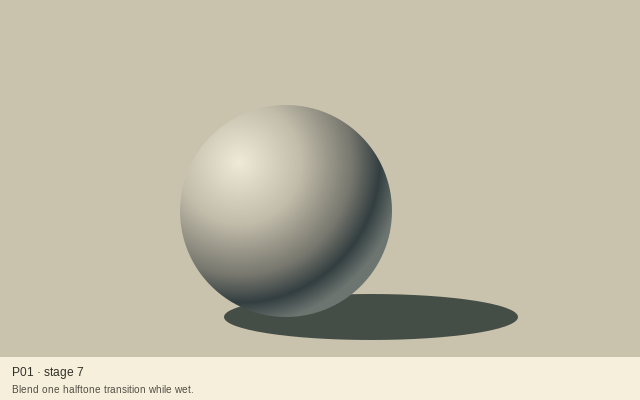
- Blend one halftone transition while wet.
Mixture, brush and checkpoint
Mixture: Use a small amount of middle value between the light and dark. Blend only the joining edge.
Tool and motion: Clean damp filbert: cross only the halftone join with two or three light curved passes.
Check: The sphere reads as round from two metres away before a highlight.
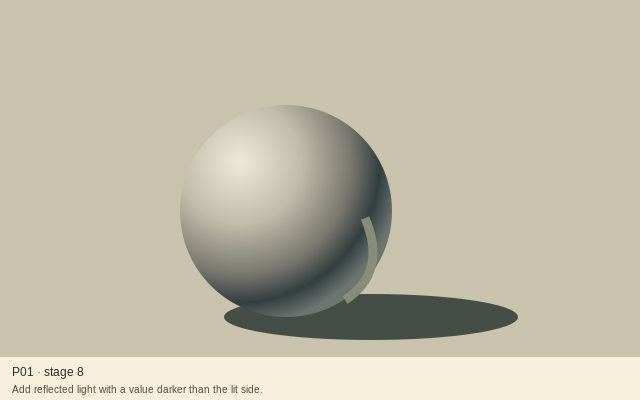
- Add reflected light with a value darker than the lit side.
Mixture, brush and checkpoint
Mixture: Use the second-darkest mixture with a tiny touch of middle value. It must stay darker than the lit side.
Tool and motion: Medium filbert edge: place a narrow muted reflected-light band inside the shadow.
Check: Reflected light is visible inside the shadow but remains darker than the light family.
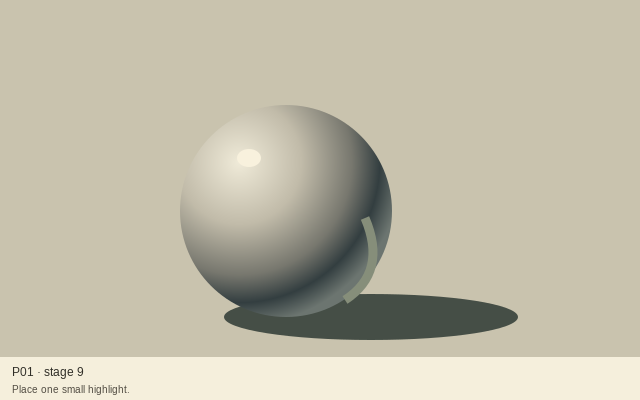
- Place one small highlight.
Mixture, brush and checkpoint
Mixture: Use the fifth pile, white.
Tool and motion: Small round: place one short highlight mark and lift the brush.
Check: There is one small highlight and the cast shadow remains attached.
Checkpoint pictures
Check the painting
At stage 7, the sphere must read as round before the highlight is added.
Repairs
- Striped form. Repaint the middle value across the transition and blend only its edge.
- Floating sphere. Connect the cast shadow to the contact point.
- Bright reflected light. Let it dry, then repaint that small strip with a darker mixture from the shadow side.