Lesson 09.01 · Texture and tools · 15 minutes
Use a palette knife
You will learn to mix cleanly and apply paint with the knife edge and face.
Review 08.05 · Paint a glazed cherry if you need it.
See it
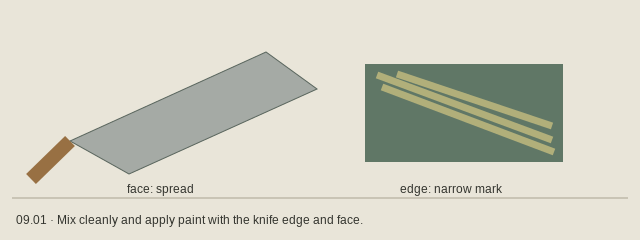
Read
Use a blunt palette knife like a small spatula. Its flat face spreads paint. Its edge makes a narrow mark. A lighter touch can leave paint on the surface with the ridges intact. Wipe the blade between colors. A smooth plastic spreader can make the same practice marks.
Palette-knife face and edge · silent demonstration
Try it
Optional screen activity · Knife mark animation
Paint it
Gather your materials
- Two acrylic colors
- Blunt palette knife or smooth plastic spreader
- Firm scrap card, palette and rag
All exercise steps
- Move one lentil-sized part of each color to a clear palette spot. Use the flat of the blade to press the paint out, scrape it back into a pile and fold it over until the streaks disappear.
- Slide the knife face under a little mixture. Hold it almost flat against the card and pull it sideways to spread one broad patch. Lift at the end.
- Wipe the knife. Pick up a little paint along its edge. Touch the edge to the card and pull it a short distance to make a narrow line.
- Pick up a small dab on the tip. Touch it down lightly and lift to deposit a broken mark. Make three such marks with different pressure.
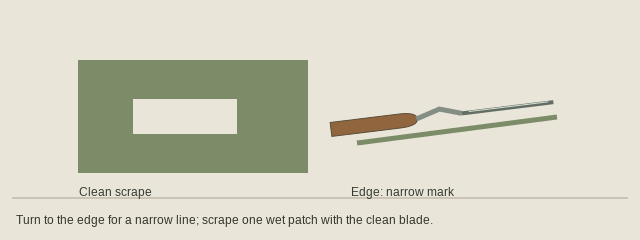
- While the broad patch is wet, wipe the blade and scrape back one corner with the edge. Wipe the paint from the blade onto a rag.
Check
What should I be seeing?
The wide patch, narrow line, broken marks and scraped corner are easy to tell apart.
Fix
If the knife pulls up the support, lower the handle and use less pressure. If a mark smears into a previous color, wipe the blade and place the next mark on a clean area.
Save
Save a physical swatch or painting photograph in your journal. Use the lesson number in its note.