Lesson 11.03 · Complete paintings · 75 minutes
Refine color, form, and edges
You will learn to develop the block-in without losing its large structure.
Review 11.02 · Ground, draw, and block in if you need it.
See it
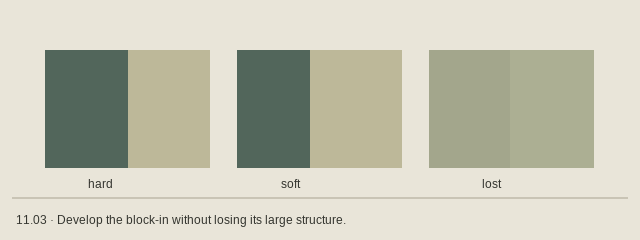
Read
Start with whatever most changes the painting at arm’s length. It is usually a large value, proportion or color mismatch. Use edges to guide attention. Keep one hard edge in the focal area and simplify weaker edges elsewhere.
Try it
Optional screen activity · Reference Desk: painting compare
Paint it
Gather your materials
- Dry block-in and reference sheet
- Dry color swatches
- Paints, medium brush and fine brush or brush corner
- Palette, water jars and rag
- Optional camera and Reference Desk
All exercise steps
- Step back and point to the biggest value mismatch. Test the corrected paint on scrap, let it dry and compare again. Paint that change in one broad patch.
- Look at the lit side and shadow together. Compare which is warmer or cooler. Adjust one small test pile before changing a broad patch on the painting.
- Keep one clean edge near the focus. Soften one edge away from it with the short feathered pass from Lesson 07.03. Let the surface dry before changing another edge.
- Place one or two small texture marks only where they describe the surface. Photograph the painting in even light and compare with the reference in grayscale in Reference Desk, or squint at both side by side.
Check
What should I be seeing?
The painting reads in broad values with a clear focus. Its darkest shadow remains connected and a few small marks describe the surface.
Fix
If new texture hides a major shape, let it dry and paint that light or dark shape back over part of the detail.
Save
Save a physical swatch or painting photograph in your journal. Use the lesson number in its note.