Lesson 06.03 · Match colors you see · 15 minutes
Match hue and chroma in small trials
You will learn to correct one color property at a time while keeping the original mixture available.
Review 06.02 · Match lightness first if you need it.
See it
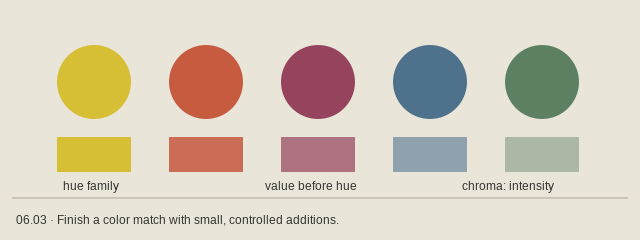
Read
First decide which direction the hue needs to move. If an orange swatch looks too red beside the target, a little yellow moves it toward yellow-orange. A small amount of the complement can mute a swatch that is too vivid. If it is already too dull, start again with a cleaner related paint or a smaller amount of the dulling addition. Check value again after every correction because an addition can change more than one property.
Try it
Optional screen activity · Color Mixer: What should I add?
Paint it
Gather your materials
- The same target and value-matched paint recipe
- A neighboring paint for the hue correction and a complement or earth paint if needed
- Palette, knife or card, brush, scrap card, pencil, rinse water, and rag
All exercise steps
- Remake your value-matched mixture if it has dried on the palette. Mark three boxes Value match, Hue trial, and Chroma trial. Paint the first sample and keep the main pile separate.
- Compare with the fixed target patch. Name a direction for the first correction, such as more yellow, less red, or more blue. If the hue is already close, leave the Hue trial box empty and use your first mixture in the chroma trial.
- To test a hue correction, move one pea-sized dab of the value match into a clean spot. Fold in one pinhead of the neighboring color. If the direction looks right but the change is too small, add another pinhead. Paint Hue trial and record the addition.
- Choose the closer dry hue. If that mixture is too vivid, move a separate dab into a clean spot and fold in one pinhead of its complement or a suitable earth color. If it is too dull, test a dab with a cleaner related color. Paint Chroma trial and record the addition. If the chroma already matches, keep your current recipe.
- Compare the dry samples in the same light. Check value again with narrowed eyes. If the best hue is now too dark or light, test the smallest useful value correction in a new dab.
Look for Your hue trial shifts in the intended direction. A complement softens a bright color. The best dry match stays close in lightness.
If the result differs If a correction makes the swatch brown or too dark, return to the untouched pile and halve the addition. Make one change at a time.
- Record the closest recipe with paint names, approximate amounts, and the dry swatch. Write down any difference you can still see.
Check
What should I be seeing?
You can pick the best dry match and name the remaining difference in hue, value, or chroma.
Fix
If none of the corrections help, recheck the patch through your card window. Match the single midtone patch you selected before comparing other parts of the object.
Save
Save a physical swatch or painting photograph in your journal. Use the lesson number in its note.